Churches in Evansville – MB
When focusing on music in Evansville, the latter half of the nineteenth century saw an abundance church music. There were many churches that were established in Evansville at this time, including Baptist, Jewish, Catholic, Methodist and Presbyterian denominations. Music has long been a strong portion of Christian worship in most denominations, and Evansville had its part in involving a congregation through liturgical and sacred music. Vocal and instrumental music in the church were considered necessary parts of divine worship, and that “there is no worship in an instrument unless played by one who has the Spirit of God” (1875). In this particular period, there were not a lot of high-quality instruments (especially organs) in the churches being built. Much of the music was vocal (sometimes choral) music, which had congregational responses and antiphons through popular psalms and hymn tunes. Instrumental music in churches really didn’t take a strong part until the early twentieth century. After Evansville became a more developed and established city, many new parishes (which still stand today) came about, along with new instruments, choir lofts and organs to aid in worship.
The majority of Evansvillians (today, and then) were Catholic, but there were a fair amount of missionaries who advocated temperance and social morality amongst the alcohol and disorder that plagued Antebellum Evansville. These missionaries were evangelical Protestants, who believed temperance was necessary to maintain liberty. Evansville was a tavern town, which soon became anti-Catholic and anti-German due to much of the disorder that over-beared the city. Protestants saw Catholicism to be the source of problems, while others saw immigrants as the root. With eleven taverns between Main St., Locust, Riverside, Walnut, Cherry and Vine, the primary social gatherings involved alcohol (and a lot of it). Alcohol poisoning was an all too common death, and public intoxication caused violence, murder and other misdemeanors to be an everyday occurrence. The Protestant missionaries greatly aided in the efforts to revitalize and nourish Evansville as a healthy, safe place to live. By the mid-nineteenth century, the taverns required licensed state ordinances in order to sell alcohol, which alleviated some of the disorder occurring in Evansville. These Protestants wanted to make Evansville a Methodist town, which never truly happened, but many Christian churches exist today with a variety of represented denominations.
As mentioned previously, much of the music represented was strictly vocal due to the lack of quality instruments and organs in a newly established city. The Catholic churches followed the liturgy of the Roman missal, meaning that the mass and its music were entirely in Latin (due to this period being before the reformations of Vatican I and Vatican II). As anywhere with a Catholic parish, Latin hymns were very traditional in upholding the teachings of the Catholic church. There wouldn’t be any hymns involving the congregation as there would be today, and much of the mass music would be Latin chants and modes. Its difficult to say what level of musical involvement there specially was in Evansville at this time in the Catholic church, but it would be a safe assumption to think that much of it were Latin chants, responsorial psalms, and liturgies passed down by oral tradition. Baptist churches at this point were almost entirely comprised of African-Americans, and much of their music involved the entire congregation through oral tradition. Spirituals, folk songs and gospel chants were the majority of vocal genres represented, in conjunction with dance, clapping, percussion and full-out expression of the music during worship. Methodist and Presbyterian churches established choirs (some with organs), which performed preludes, anthems, simple chorales, meditations, postludes and hymns. Music selections matched the sermon and readings for the week, and attempted to involve the congregation through common hymn tunes found in the corresponding missals and hymnals. Though Evansville was not especially a pioneer of music in the church or of sacred compositions, it certainly had its place in making sure that music was an integral part of worship. The establishment of many new parishes and schools helped aid this value, and further supported the idea of congregational involvement, the recruiting of church choirs, the purchase of organs and music to be an extension and aid to the sermons and readings presented in the church.
Butler, An Undergrowth of Folly
Elliott, A History of Evansville and Vanderburgh County
(1875, November 11). Evansville Journal, p. 8. Available from NewsBank: https://infoweb.newsbank.com/apps/news/document-view?p=WORLDNEWS&docref=image/v2:1425EEF26DF1B8D5@EANX-NB-14546BB341EE6736@2406204-1450754843B8777B@7-1450754843B8777B@.
(1894, October 18). Evansville Journal, p. 2. Available from NewsBank: https://infoweb.newsbank.com/apps/news/document-view?p=WORLDNEWS&docref=image/v2:1425EEF26DF1B8D5@EANX-NB-145514864CB3B1B5@2413120-14526F2B929CB9A9@1-14526F2B929CB9A9@.
Restoration of Giesecke Organ at First Presbyterian Church – MB
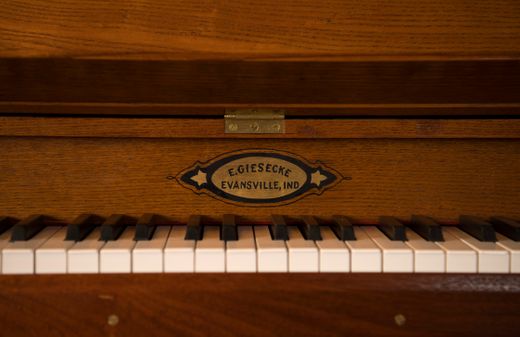
A German immigrant brought music to Evansville back in the mid-1800s. More specifically, Edmund Giesecke arrived to the River City with a talent, a talent for creating pipe organs. But only five of his air-powered instruments are known to have survived the many decades since they were created, and one of them has found its way back to where it all started — Evansville.
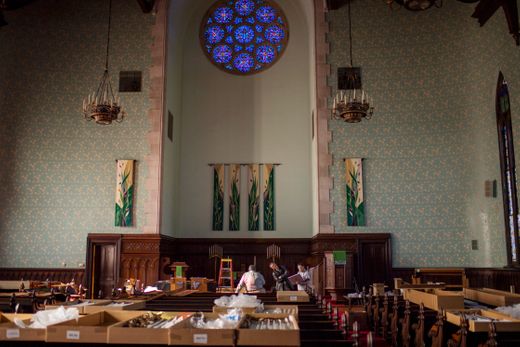
A fully mechanical pipe organ, circa 1897, was originally built for a small church in Wisconsin. The organ found its way to Maumee, Ohio, in 1962 where it made music for a Lutheran Church for many decades before the church was sold to a family-run business. The family contacted the Evansville Chapter of the American Guild of Organists offering them to the opportunity to purchase the aged instrument. The group jumped at the chance. The organ was shipped to Evansville’s First Presbyterian Church, care of Robert Nicholls, director of music and dean of the American Guild of Organists in summer of 2016.
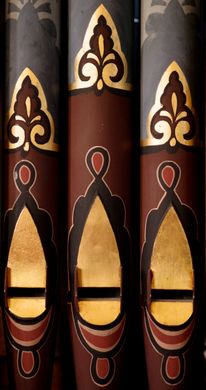
About one year later, with refinished chestnut, freshly voiced pipes, a new blower (as well as a hand pump for the bellows), resurfaced keys and many other renovations, the 366-pipe organ came back home where it will be used for worship, education, concerts and community events at First Presbyterian Church. The hope is it will be used by many organizations.
Minstrel Shows – Morgan O’Beirne
Minstrel shows were commonplace, and their history is complicated. These shows were considered entertainment, and Evansville took part in the rise of their popularity. Minstrel shows typically consisted of:
- White actors performing in black face
- Exaggerated dance moves typical of black culture
- A “comedic” sketch about black people and their culture
None of these things are acceptable anymore, obviously. However, it is integral we recognize it happened in Evansville. In Bigham’s We Ask Only A Fair Trial, an instance of a local minstrel show is described:
“The idealization of white culture sometimes took curious twists. A poignant illustration of that occurred in December 1901, when thirty-five of the leading ladies of the city—among them Mrs. Annie Morgan Viele, Mrs. Mose Strouse, Miss Louise Dunkerson, and Miss Bessie Heilman—put on an amateur minstrel show for the benefit of the Free Kindergarten Association. Headlined as “sweet ladies of black face,” the event was received enthusiastically by a large white audience. The society women reportedly charmed the crowd with their ‘ludicrous’ costumes and jokes” (Bigham 85).
These shows took place in Evansville and community members participated in them; during this time period, it was a popular form of entertainment. My research on black society in Evansville gave me a more complete understanding of all music in the area. It’s essential to recognize music in its entirety, and that includes black bands and music. The minstrel shows are uncomfortable to read about, but it is supposed to make us uncomfortable. The following article does as much with its description of a series of acts within a minstrel show:
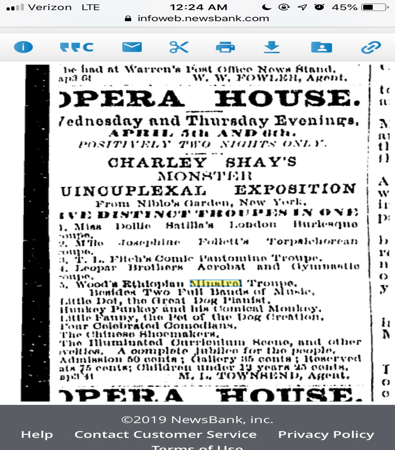
Although content on minstrel shows was inconclusive in the Evansville historical newspaper database, it’s obvious the names of the sketches had racist intentions. It’s a part of the city’s past that correlates to music and should be recognized and not swept under the rug.
Sources:
Bigham, Darrel E. We Ask Only a Fair Trial: a History of the Black Community of
Evansville, Indiana. Indiana Univ. Press, 1987.
Music on Streckfus Showboats
Captain John Streckfus founded the Streckfus steamboat line in 1884 when he revamped his company to establish trade through some riverboats he maintained. Streckfus Sr. was actually the person that initiate putting music aboard their line of steamboats. The family was musically inclined, and Captain John played the violin along with expecting his children to learn instruments as well. The Captain sought to attend rehearsals often, and he was very strict about attendance and following instructions; he was known to fire anybody who didn’t adhere to his guidelines. Captain Clarence W. Elder commented on Captain Streckfus’s management of the band on the ship during his tenure there:
“Captain Joe Streckfus was very particular about music on the Streckfus excursion boats. He would attend rehearsals, tap his feet with his watch in his hand, and if the band failed to keep the proper tempo (70 beats a minute for fox trots and 90 for one steps) somebody got hell. If it happened too often there were new faces on the bandstand. Captain Joe in my opinion was the man who did most to exploit music in my day. The men themselves of course were talented, but it was Capt. Joe who provided them the place to start. He personally trained some of them, always insisted on regular rehearsals, and strove for perfection. He had an uncanny sense of values when appraising a musician, and in audience reaction.” (Chevan 159)
Elder’s description of the steamboat Captain helps us understand that Streckfus was quite respected even though he had some odd tendencies. Streckfus quite literally ran a tight ship, to say the least, but his boat’s band was very well rehearsed because of it. In addition, Captain Joe gave many musicians their start on his ship, and this generosity was not forgotten. A black pianist by the name of Charlie Mills was hired in 1903, and he played with white musicians on the ship in the same band; there wasn’t much commentary on this, but it’s still a notable event. The J.S. sank in 1910 due to a fire, but before the incident, the ship saw many talented musicians in its time—including Louis Armstrong.
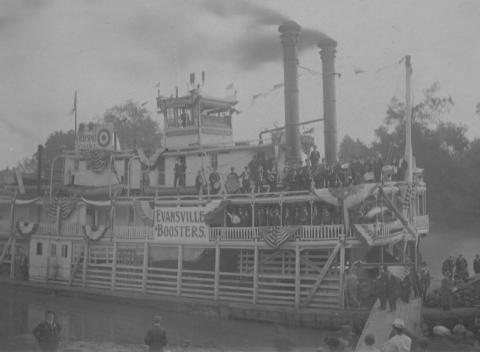
“Riverfront: Ohio River and Pigeon Creek.” Willard Library, willard.lib.in.us/research/archives/historic-photo-collection/riverfront-ohio-river-and-pigeon-creek?page=1.
Calliopes
Another prominent aspect of showboats were the calliopes on board. A calliope is a stream-powered organ, and a person would be hired to play the instrument as entertainment when making stops in different ports on the river. A calliope looks like this:
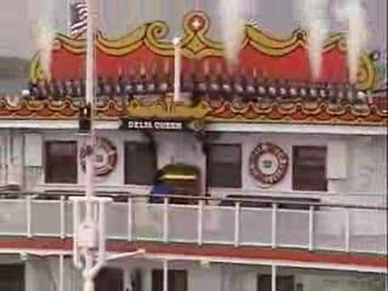
Showboats really valued their calliope players; there was even quite a bit competition among them. Some showboats with calliope players would attempt to outplay others passing by, and it was almost comparable to sports teams competing against one another it seems. When a showboat with this powerful instrument would come to port, it’s said the calliope’s resounding tunes could be heard nearly seven miles inland. In Philip Graham’s presentation on showboats and calliopes, it’s stated that “More than any other object, the calliope became the symbol of the showboat, its reverberating echoes inseparable from the glamour of the stage and beauty of the lighted rivers” (234). Clearly, these steam-powered organs and their players carried considerable respect and adoration among those on the boat and on land.
Performance Halls and Theaters – MC
St. George
- A fine establishment, the scene of an elaborate Charity Ball on NYE in 1910
Pigeon Springs Hotel
- Located on West Maryland Street and the south side of the banks of Pigeon Creek
- Combination health and amusement resort that opened in the 1840’s
Apollo Hall
- “Lenore, the Bride of Death” was the opening stage play on July 19th, 1852
- Hall later renamed Mozart Hall
Marble Hall
- First puppet show ever given in Evansville
- Located at 17 Main Street
- Became one of the first nickelodeons in southern Indiana
National Hall and Marlette’s Hall – Morgan O’Beirne
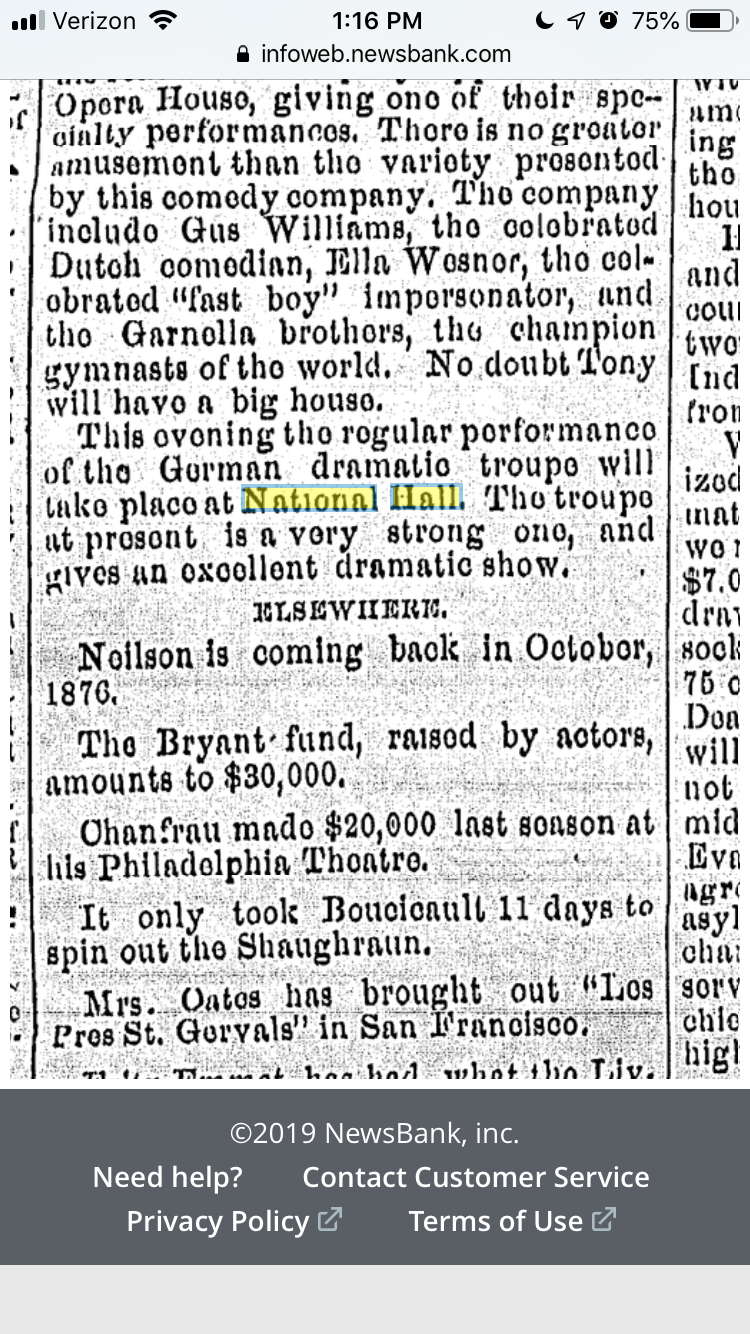
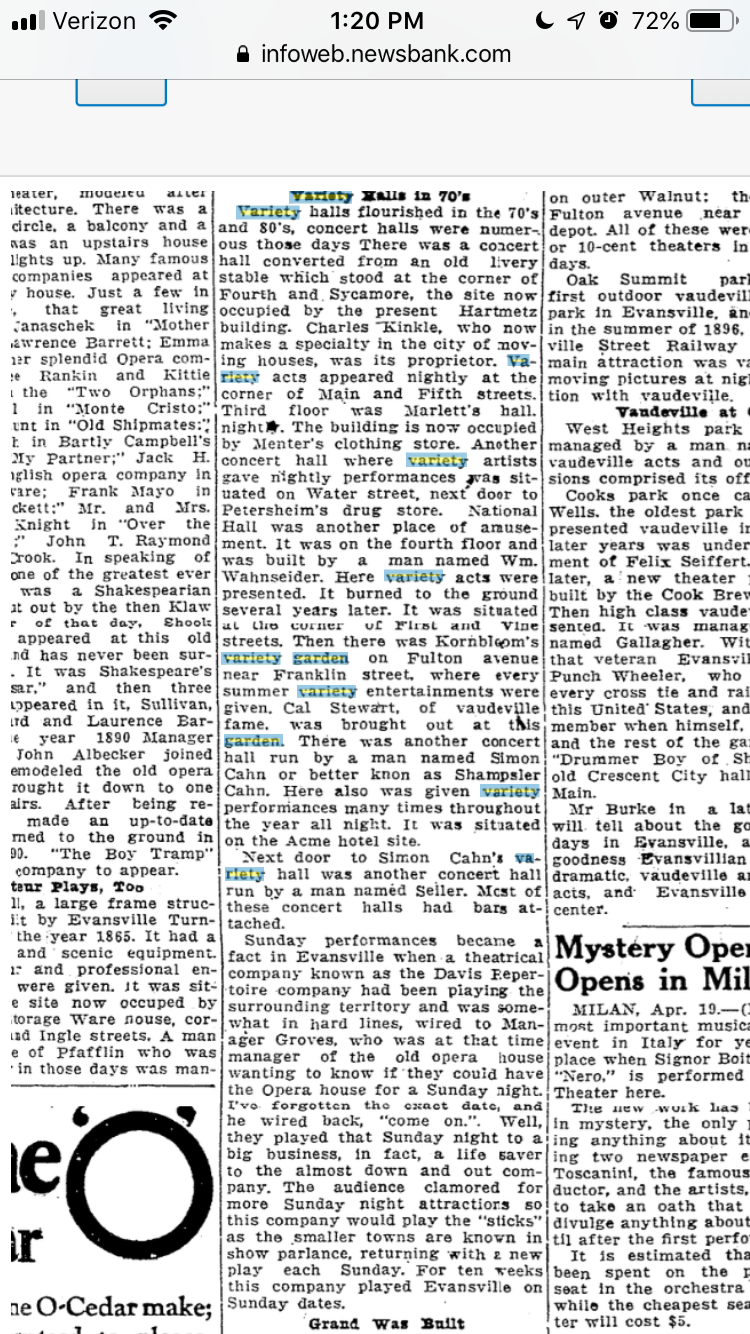
National Hall was owned by William Wahnseidler and it was located at First and Vine on the fourth floor of the building. It wasn’t run like a continuous business because it was leased to different groups that wanted to use it for entertainment, group gatherings, lectures, etc. Marlette’s Hall served a similar purpose.
Variety Garden and Buschnell Gardens -Morgan O’Beirne
Variety Garden on Fulton Avenue was an outdoor venue with a fence that served as a screen. It had a small stage and a space for dancing. Bushnell Gardens was also a similar venue and, in addition, had Native American relics, various objects from Germany, and wood carvings made by locals. This venue was located at Second and Sycamore. These places were often attached to another building where shows could easily be moved indoors in case of inclement weather.
The Metropolitan
- Formerly Mozart Hall
- The Golden Players opened there in 1865
The Evansville Opera House – Madeline Cox
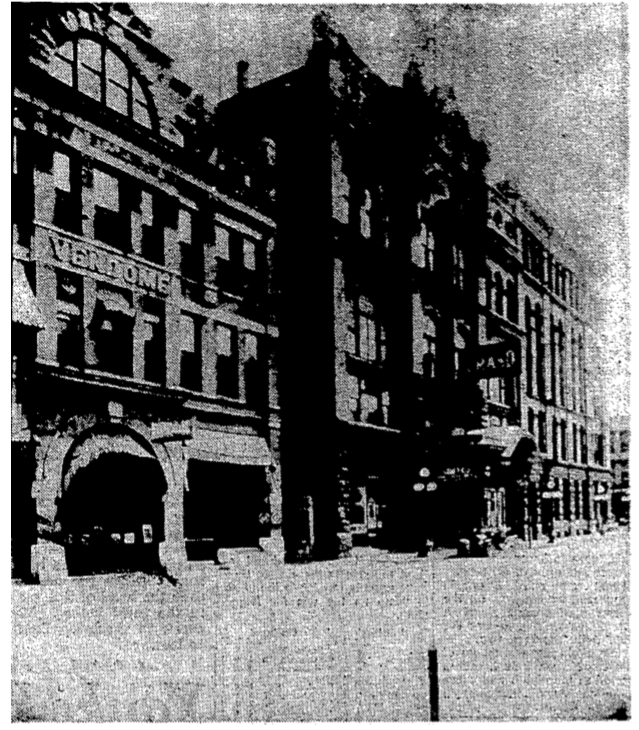
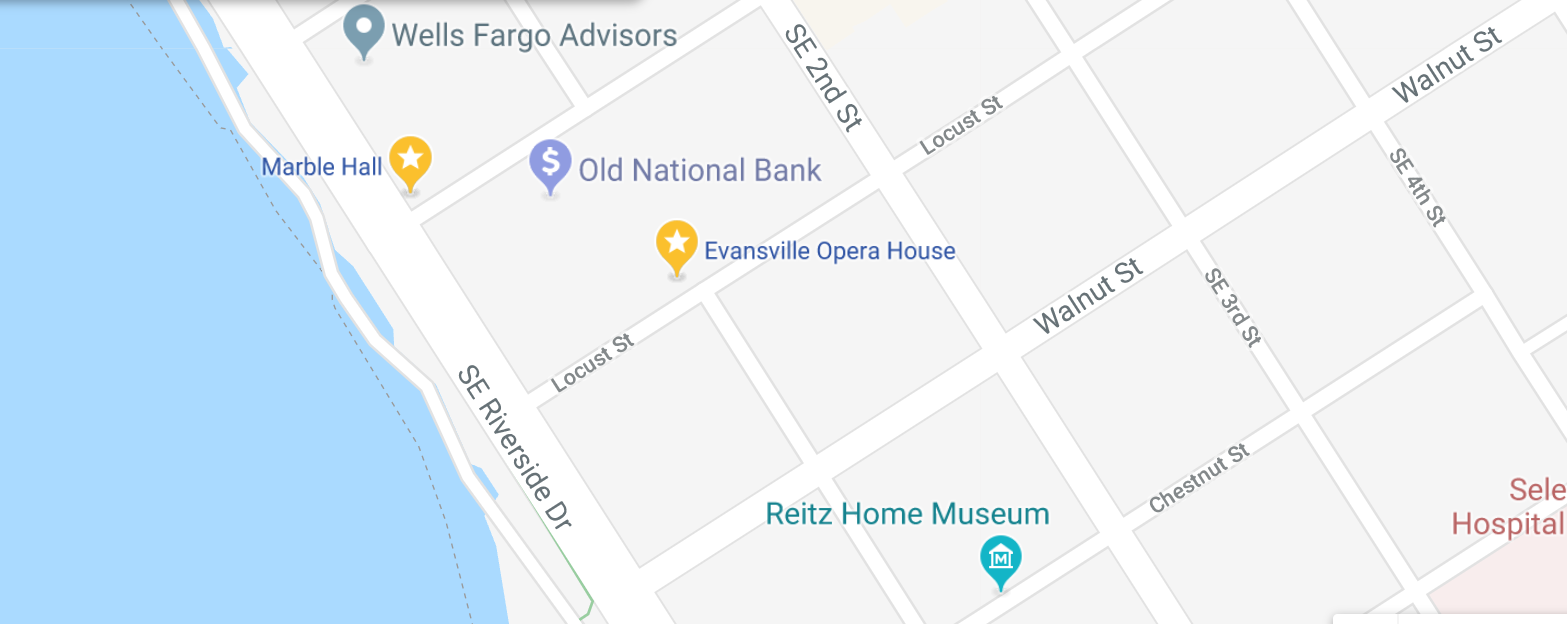
The Evansville Opera House was built in 1868 on First and Locust Street. The performances took place on the second floor of the brick building, powered by gas lights and small gas jets for footlights. The stage itself was thirty-two feet wide with a lot of depth to provide large sets. The theater was described to be a very handsome space for performance. The Grand Opening of the theater took place on September 9th, 1868, and featured many local talents, including Professor Mathias’ Orchestra. The next evening was a formal opening with a performance entitled “The Morning Call”. Ticket prices were also very affordable. You could pay 25 cents for the second balcony or $1.00 for general admission to the main floor. In 1868, $1.00 would equate to $17.26.
There were many great shows that circulated through the theater, and at the end of the theater season in 1890, it was announced that there would be a $20,000 remodel of the theater and rename it “The People’s Theater”. After the renovation, the theater opened the new season with the stage production the the play Dad’s Girl. Unfortunately, the newly remodeled theater lived a very short life. On February 23rd, 1891, the theater was destroyed by a fire with a loss of $80,000 dollars. In addition to the theater, The Evansville Journal building on the back side of the theater was also destroyed.
After the Evansville Opera House was destroyed, the owners of the building decided to rebuild the theater in the exact same location and name it “The New People’s Theater”. The rebuild did not take very long, and in 1892, the grand opening took place with a double bill including Marion Manola and the John Mason Company with “The Army Surgeon” and “If I Were Yours”. The building was now completely dedicated to the theater, with a full stage, balcony, box seats, and a gallery.
Grand Theater
- Known as Evansville’s finest performance hall
- In 1889, The Emma Abbott Opera Company opened at the hall with “Lucia, Bride of Lammermoor”
New Majestic
- Opened on Christmas day in 1909 with 1000 seats
- Popular priced Vaudeville tickets
Wells Bijou
- Located on the west side of Third Street between Locust and Walnut
- Opened in 1906 with the musical production of “The Elam Tree”
The Victory Theatre
- The last of Evansville’s large theaters
- Grand opening on July 15th, 1921 with a vaudeville and an orchestra concert with organ
Memorial Coliseum
- Opened in 1917
- Located at Fourth and Court Street
- Evansville’s first large space for hosting large showings and events
Apollo Theater – Morgan O’Beirne
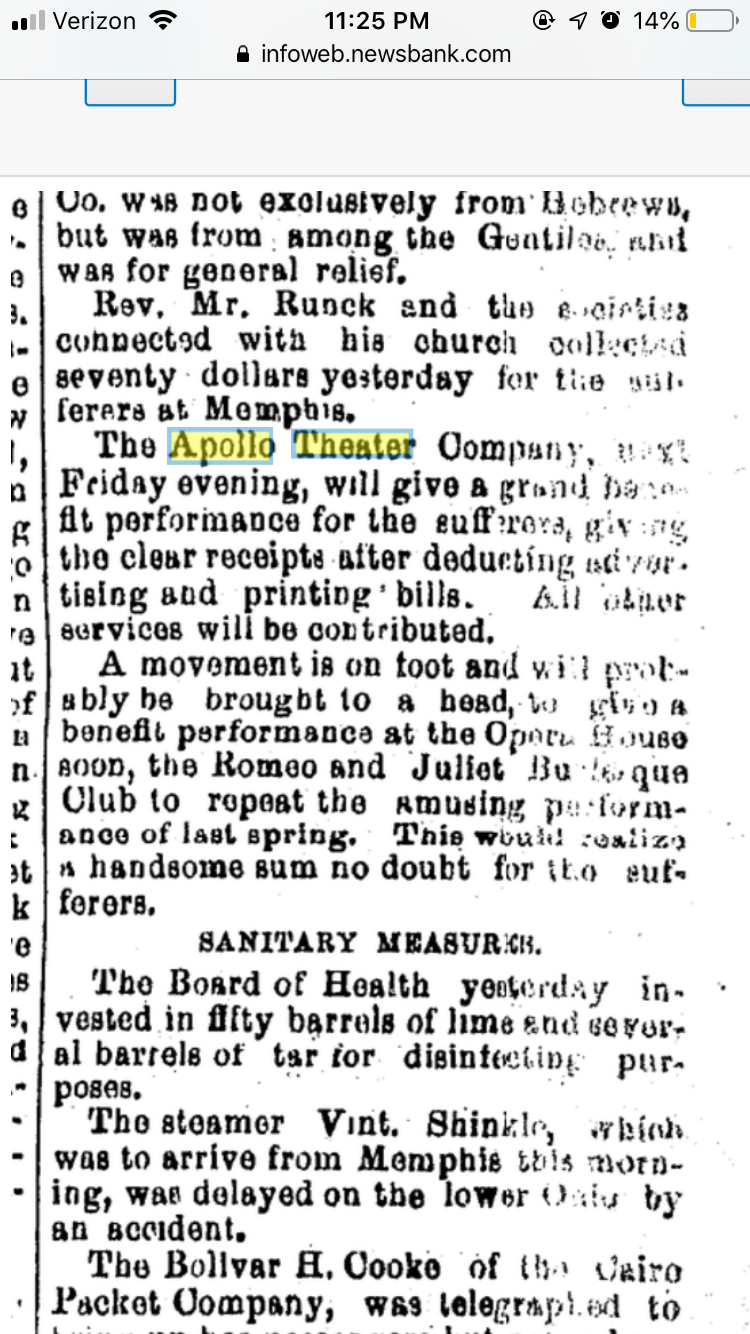
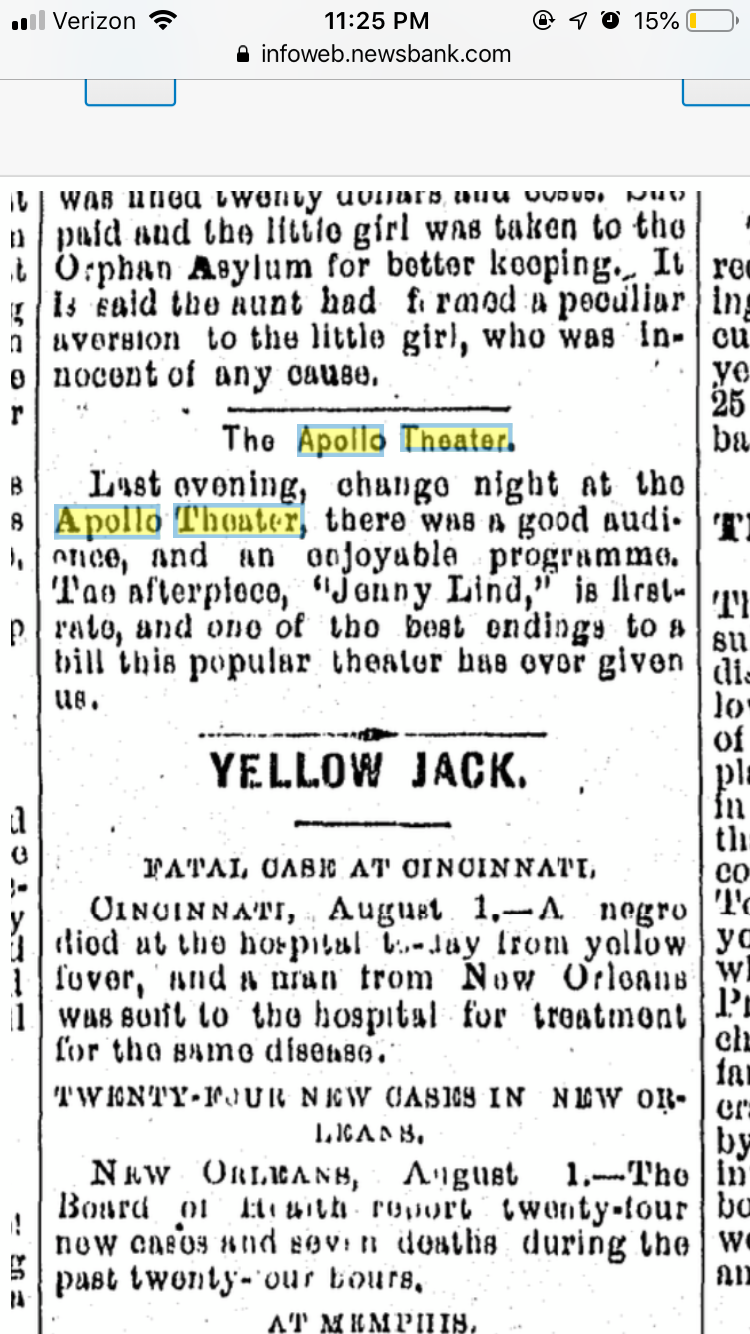
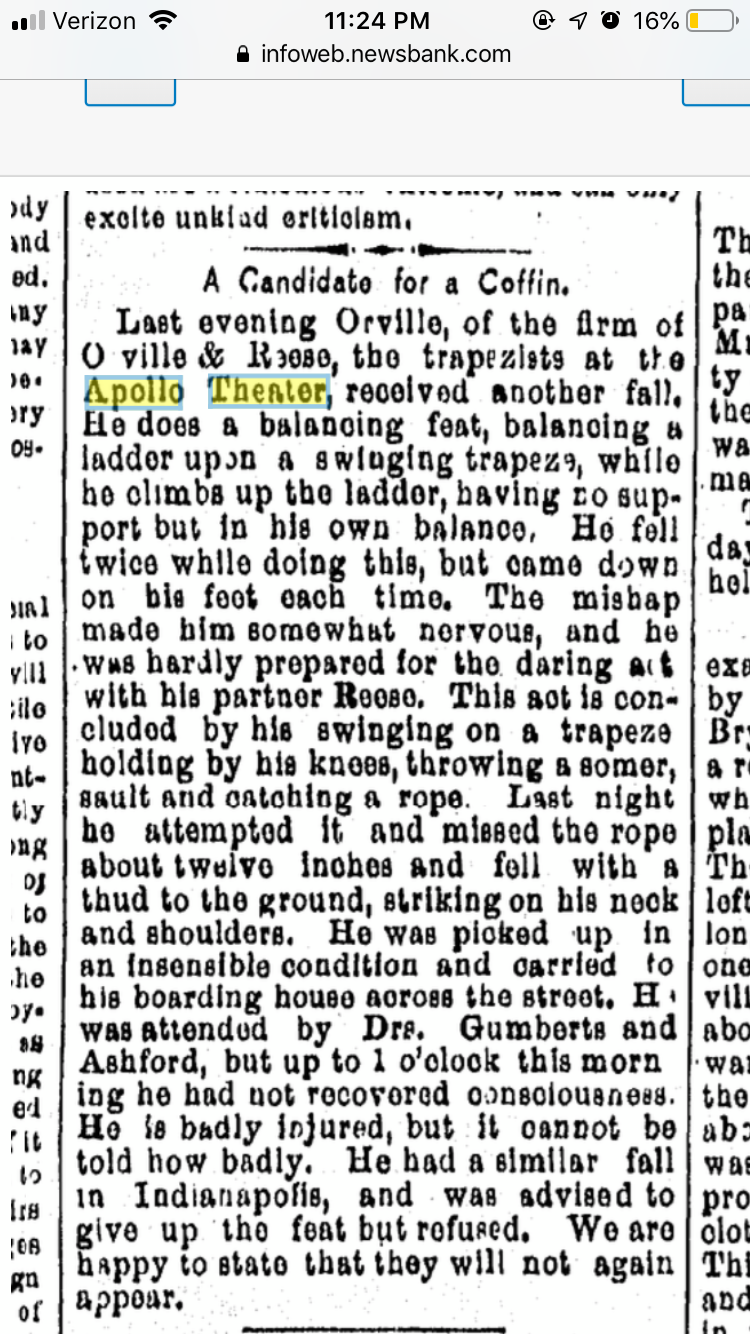
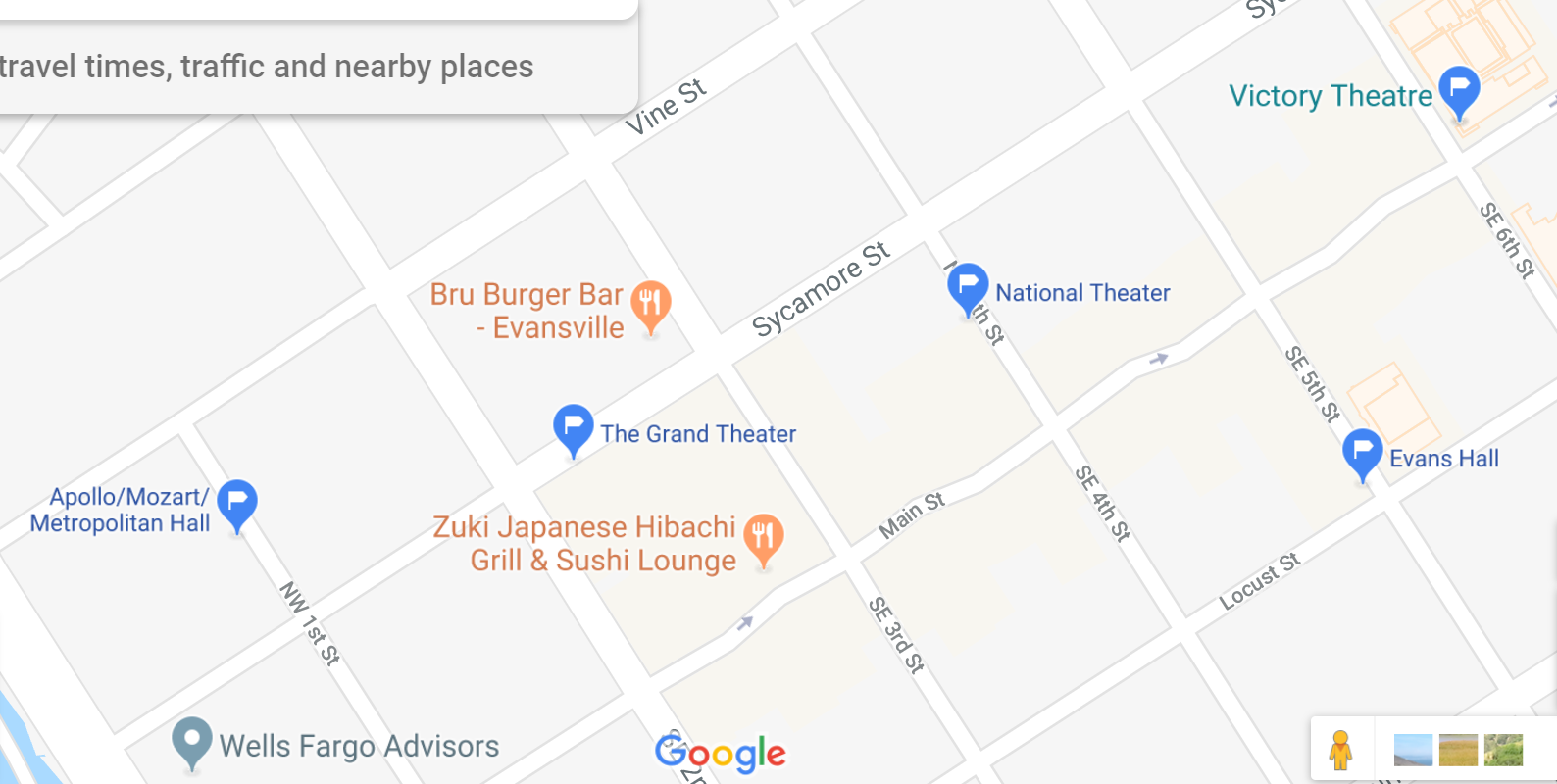
Apollo Hall was located on the west side of First St. between Sycamore and Vine. It’s grand opening was July 19th, 1852. The manager was H.S. Stasser and the opening play was “Lenore, the Bride of Death.” The theatre was also referred to as “The German Amateur Theatre.” It was later renamed Mozart Hall and then again renamed The Metropolitan after it was remodeled under new ownership. This venue reopened as The Metropolitan on September 25th, 1865. The building was ultimately destroyed in a fire in 1883.

Sources:
Chevan, David. Riverboat Music from St. Louis and the Streckfus Steamboat Line.
Graham, Philip. acebb.evansville.edu/bbcswebdav/pid-520786-dt-content-rid2981238_1/courses/MUS-357-01.2019SP.39247/Graham-%20Steamboats%20and%20Calliopes.pdf.
Knecht, Karl K. Was It Yesterday? The Evansville Story: Theaters and Entertainment. Edited by James E Morlock, 1980.
Soldiers and Sailors Memorial Coliseum – MB
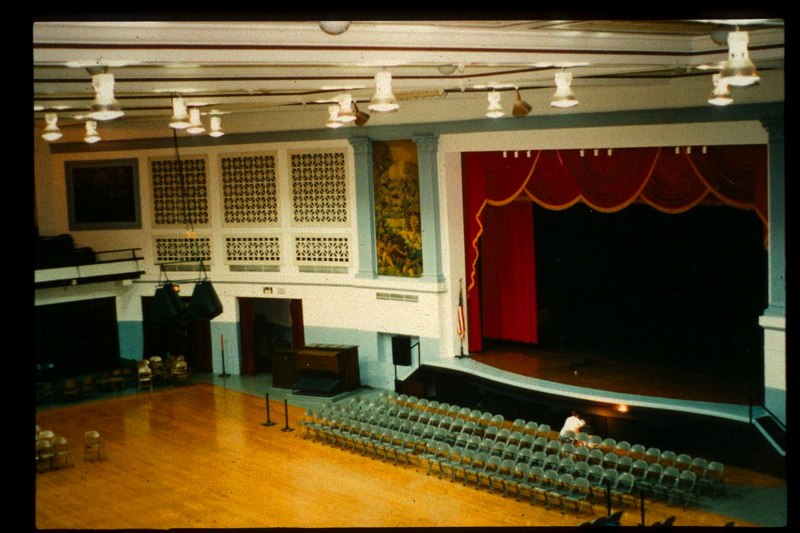
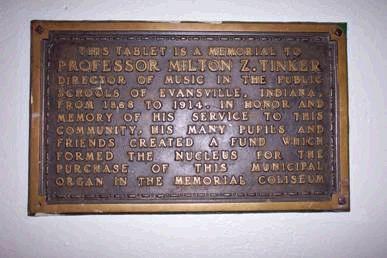
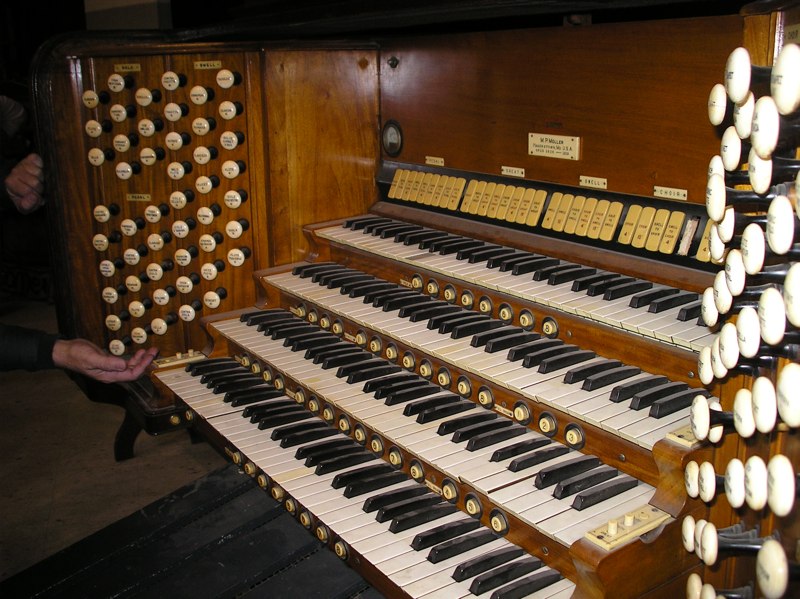
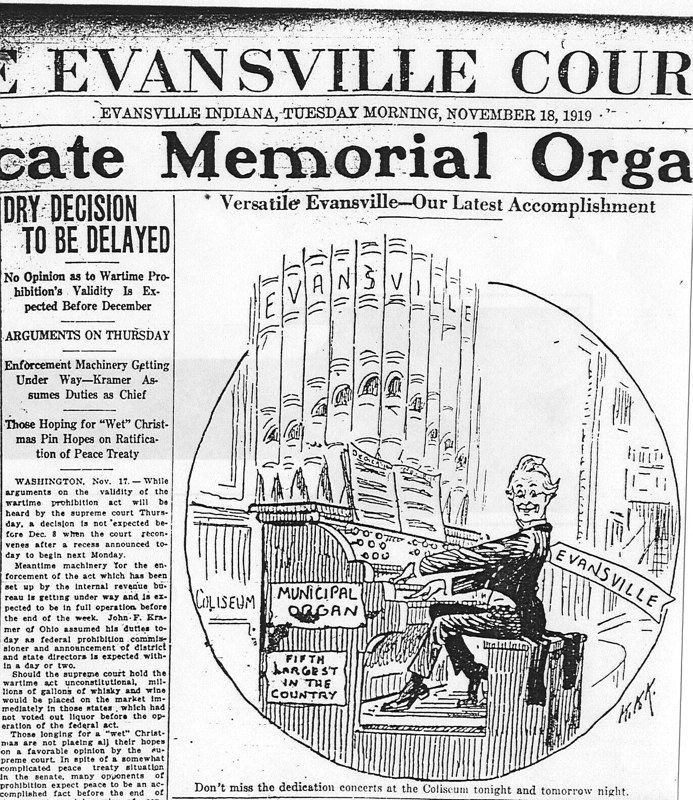
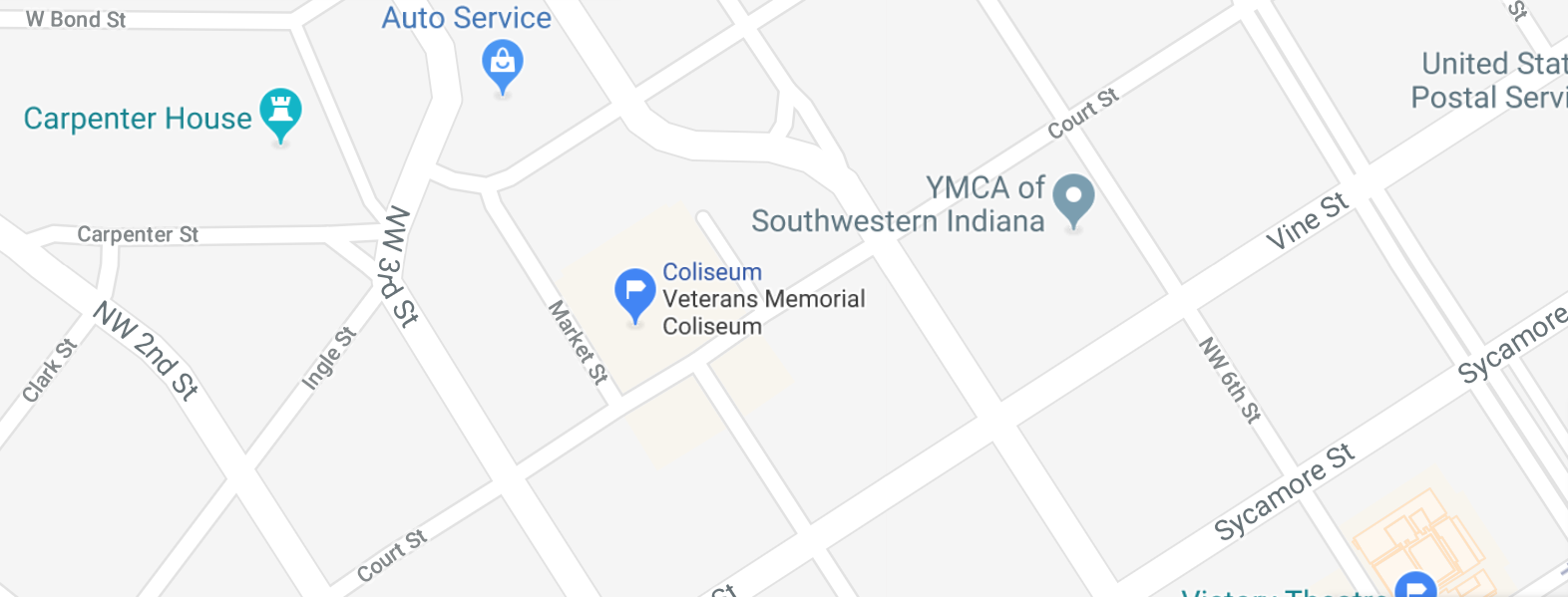
The Coliseum was built in 1916 to commemorate the soldiers of Vanderburgh County who fought in the Civil War and the Spanish-American War. It is located on 350 Court. St. in downtown Evansville. In 1919 a 4,000 pipe concert organ was installed as a memorial to Prof. Milton Z. Tinker, who was the supervisor of music in the local public schools for 47 years. At the time of its installation it was among the largest municipal pipe organs in the world. In 2013, the University of Evansville purchased the pipe organ, dismantled it, and put it into storage. Today, it serves as a multi-purpose auditorium and venue space for events such as bingo, musical productions, wrestling, roller derby, wedding receptions, stage plays and concerts.

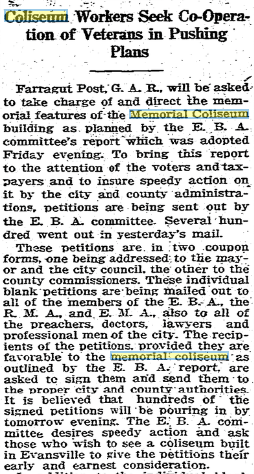
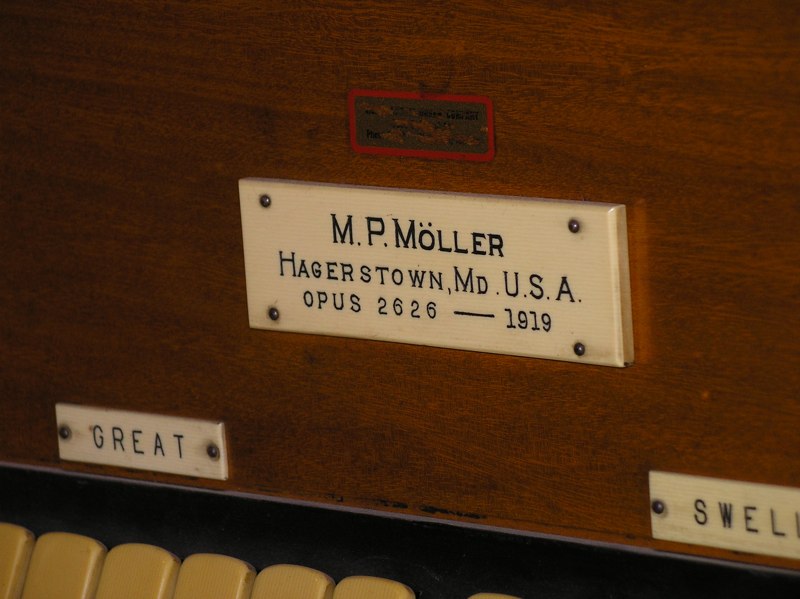
In 1919, Alfred Hughes, the first president of Evansville College, urged the city of Evansville to purchase a great concert organ, hailed as “one of the largest organs in the United States.” While attending the Methodist Centenary in Columbus, Ohio, President Hughes had learned that the convention hall organ, built by the M.P. Möller Company, would be available for purchase after the centenary celebrations. Evansville College pledged $5000 toward the purchase of the $35,000 organ. The four-manual and pedal organ with six divisions was placed in the recently completed Soldiers and Sailors Memorial Coliseum in downtown Evansville. The more than 5000 pipes range in size from tiny metal tubes smaller than a pencil to massive wooden boxes thirty-two feet long by two feet square.
Victory Theatre – MB
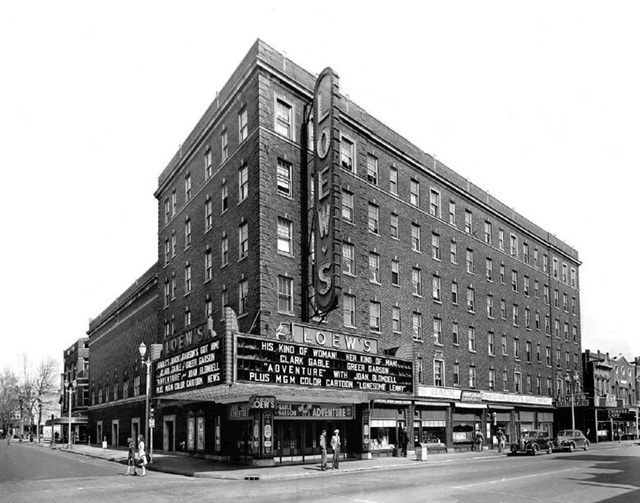
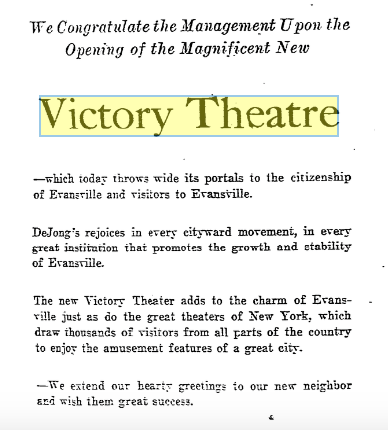
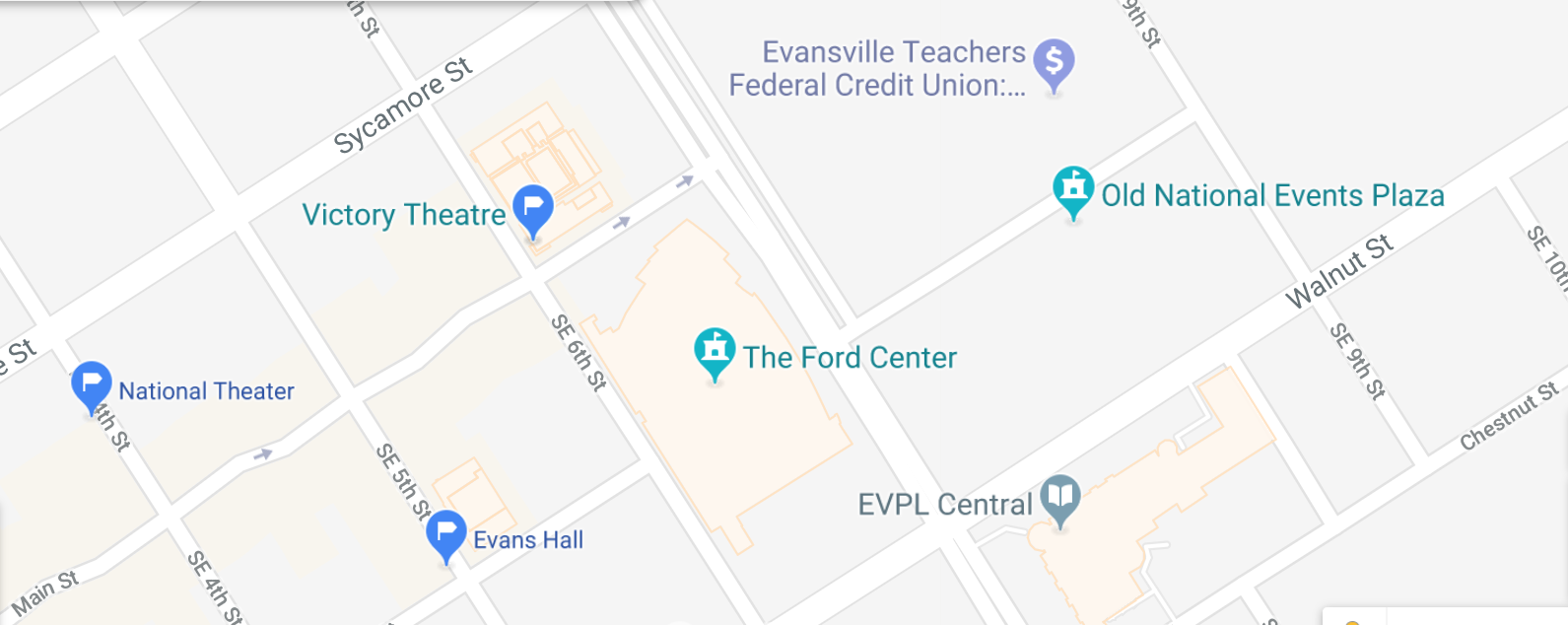
The Victory Theatre was constructed in 1921, originally seating 2,500 people. It is located on 600 Main St. in downtown Evansville. It was part of the Sonntag Hotel, and was first used as a venue for vaudeville, organ music, comedy acts and a ten-piece orchestra. Eventually renamed Loew’s Victory in 1926, it operated as a movie theatre. After closing in 1979, it was reopened and renovated in 1998. It is now attached to Signature School, seats 1,900 people and the theatre no longer has an organ. Today, it hosts ballet companies, concerts, the Evansville Philharmonic Orchestra, theater companies and touring productions.
Mozart Hall
by Devyn Haas
Mozart Hall was one of the Halls in Evansville, this hall was just more than an entertainment hall for music and shows. People would go there for speeches or for resolutions to be passed. Specifically in an article on December 16, 1876, “A large and enthusiastic audience gathered tonight at Mozart Hall. Resolutions were passed, and speeches were made by Mayor Warder, Hon. J. Theo. Bachley, Dr. Sherrod, and a number of others. Music, bon fires, fire-works and general rejoicing was the order of the evening,” (Evansville Courier and Press). This is proof that Mozart Hall had more than just a musical significance in Evansville.
Mozart Hall was where everyone went to stay connected to one another, in other words to be someone and be in the group. After doing some more digging, Evansville actually had more than one Mozart Hall. Joe Engler created a timeline of about Mozart Hall and here are the major points about the hall. The first Mozart Hall was first named Apollo Hall in 1852; which became Evansville’s first theater. Shortly after Apollo’s Hall they renamed the hall as Mozart Hall. The original Mozart Hall lasted until a fire in 1882. After the fire Lannert and Barenfanger bought property and rebuilt a theater calling it Evansville’s Singer Hall in 1884. The Evansville’s Singers Hall lasted until 1893 when the renamed it Mozart Hall again (Engler, Historic Evansville). This is one of the reasons it was hard to track down information about the building is because throughout the years they changed the name multiple times. In figure 1 you can see the rebuilt Mozart Hall, Mozart hall still stands today but is now considered by a new name, Signature School. Signature School is located on Southwest side of 1st Street between Sycamore and Vine. The original Mozart Hall was on the west corner of Sycamore and 5th Street. That is not much of a distance from the original Mozart Hall.
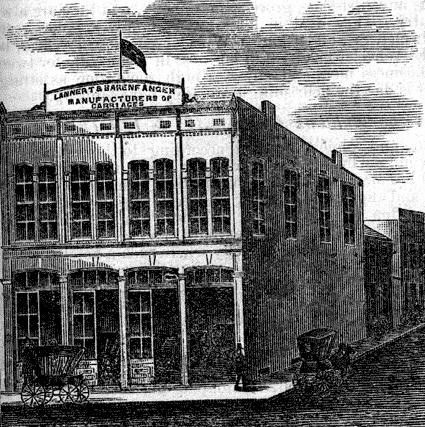
http://historicevansville.com/site.php?id=lannertbarenfanger
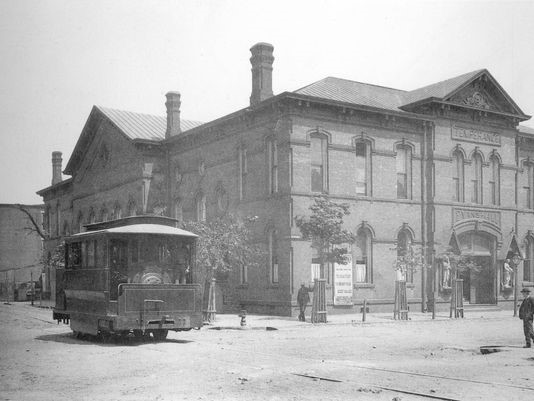
https://historicevansville.com/site.php?id=evanshall
 Music in Evansville, Indiana: Civil War to WWII