Warren’s Crescent City Silver Band (1862-1883)
Also see George Warren in “People” page
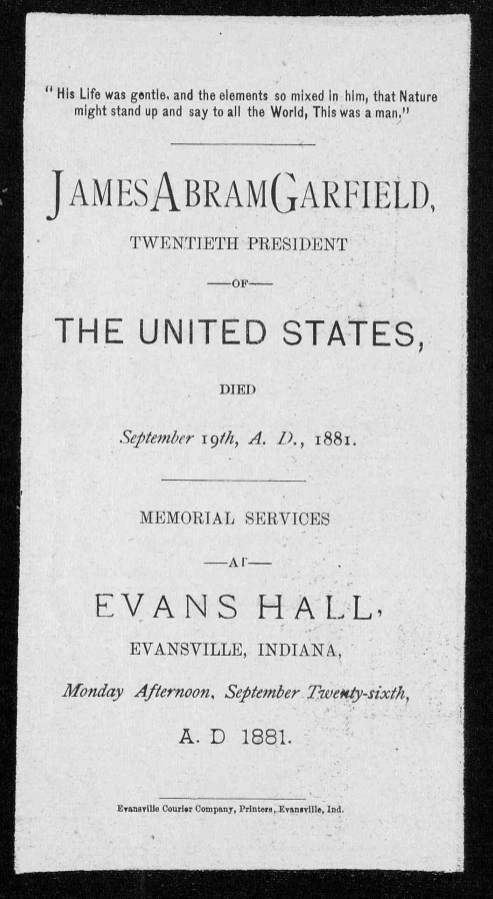
Program cover from a memorial service for Pres. Garfield 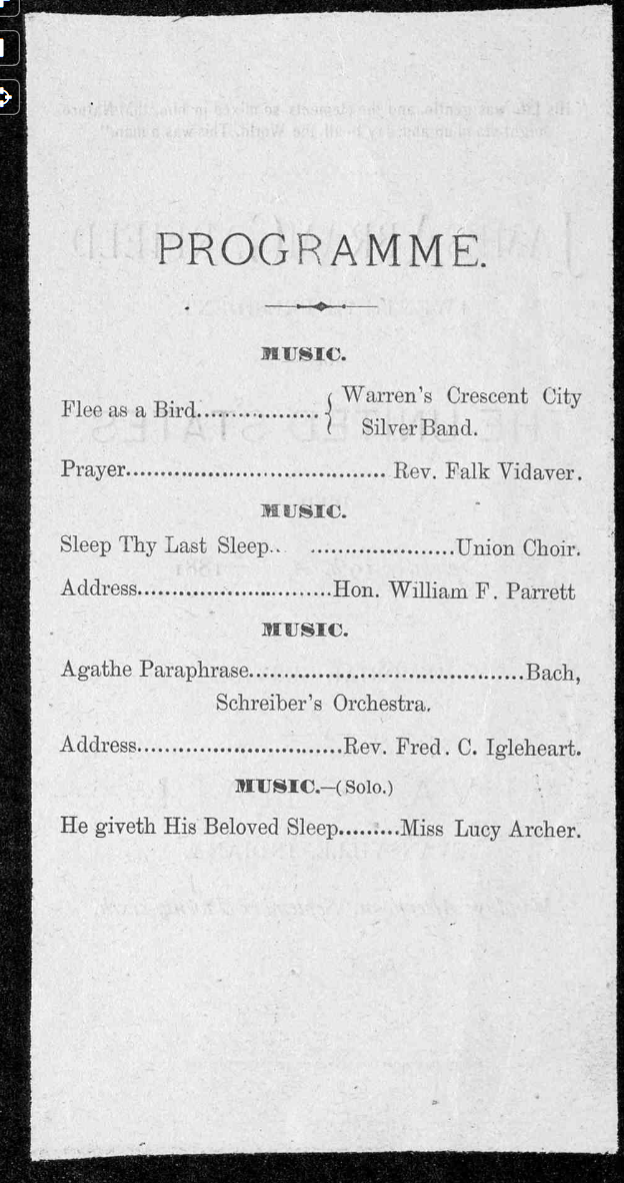
Warren’s Band and Schreiber’s Orchestra were featured
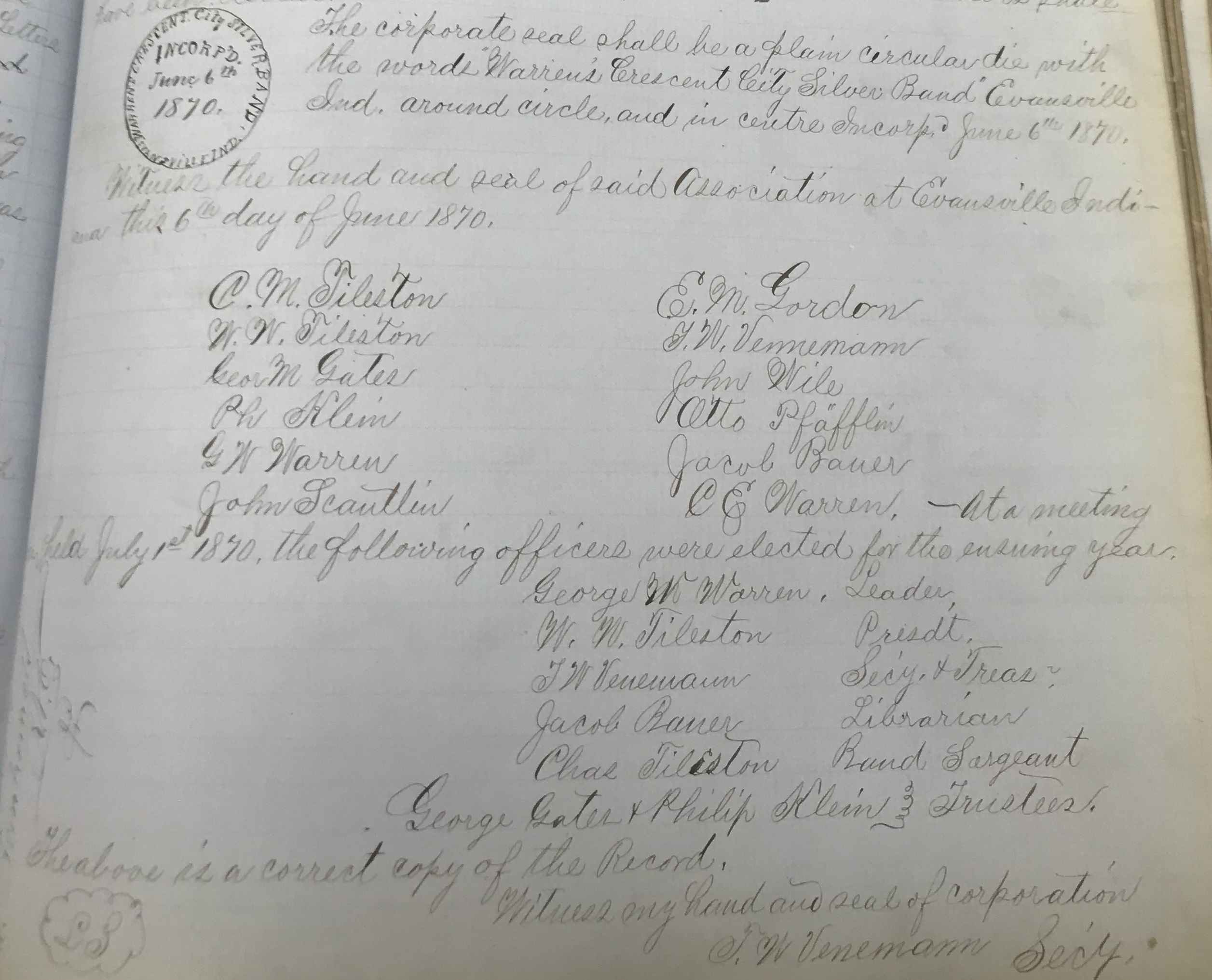
Warren’s Crescent City Band (Crescent City Silver Band)
-Devyn Haas
The Crescent City Band was founded by George Warren. “Prof. George Warren, one of the greatest musicians this section of the country ever knew, lived at that time, in New Harmony, but he thought a great deal of the Evansville boys and frequently came over to play with them.” (Gilbert History of the City of Evansville and Vanderburgh County, Indiana 93). In a previous paper I discussed how George Warren was a professor and founded many societies such as the Crescent City Band along with Evansville’s 15th Regiment Band. There is a photo that shows Warren’s band was a marching band. With their style it does represent how marching bands look today with their uniforms along with their drum major. Their uniforms were also to show that it was like a military band because most of the performers were part of the military and George Warren wanted to pay the respects of the soldiers that were in the military.
The Making of the Evansville Philharmonic Orchestra – MB
In 1868 Milton Z. Tinker was hired to be the Director of Music Education for the Evansville public schools. The stern Tinker insisted that grade school children be taught to read music notation and sing on key at the same time they were taught to read and write English. This, as may be expected, generated resistance among the children. He remained the music director for the schools for 47 years, until his retirement in 1914, and his education program had a tremendous impact on the musical development of the city.
One problem associated with the development of an orchestra in Evansville was the ability of the community as a whole to provide training on all the instruments required to form an orchestra. The prevalence of the marching bands indicates that there was instruction available for wind and percussion instruments. The local pipe organists provided instruction on keyboard instruments. But instruction for string instruments was a problem. And many string players are needed to form a symphonic orchestra. The struggle to establish an orchestra in Evansville was hampered by the lack of string players. Tinker himself helped try to form a symphonic orchestra in Evansville. In 1873, the Evansville Symphony Society gave a concert with Tinker and Mr. C. C. Genung as conductors. These early attempts to form an orchestra were unsuccessful. Tinker’s early instruction in the public schools taught choral music, and it wasn’t until 1917 that instrumental instruction was added to the music program of the school system.
Meanwhile, local organizations brought touring opera and symphonic groups to Evansville. By the 1870’s Evansville possessed an Opera House, and the ever popular marching bands could be enjoyed at Mesker Park or the Apollo open air drinking garden. In 1890 a group of Evansville Women established the Matinee Musicale, which utilized local musicians to provide programs of fine art music. The Musicale gave twelve performances a year using local musicians, and was modestly successful during its short life. In a few years, it too failed. In recognition of Tinker’s accomplishments, the city, meaning his former students, dedicated the pipe organ at the Memorial Coliseum in his name. The Tinker Pipe Organ, in deteriorating condition, now awaits restoration at the Coliseum.
In 1923, Evansville again attempted to establish a full time symphony orchestra, called the Little Symphony Society. Johanna Hansi was one of the driving forces. Conducted by James Gillette, the organist at one of the local churches, the musicians were drawn from the professionals of the theatre house bands, and from the students of the Humphreys school. After two years of performances, this group also failed. The failure of the Little Symphony Society postponed, but did not stop progress in Evansville towards an Orchestra. The ever active Hansi developed the musical talent of the church into a performing group that was often referred to as the Trinity Church Symphony. After the death of Hansi in 1929, some musicians from the group decided to continue playing together informally. The stated goal of this group was to eventually form an Evansville Symphony Orchestra. The small group was to pursue this goal for nearly five years before achieving success.
Vanderburgh Cornet Band Morgan O’Beirne
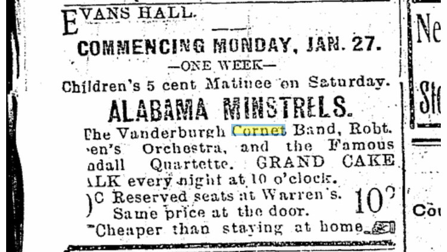
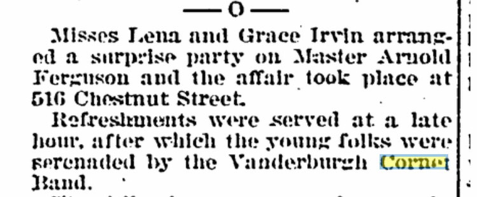
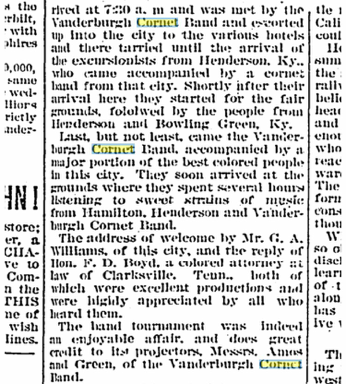
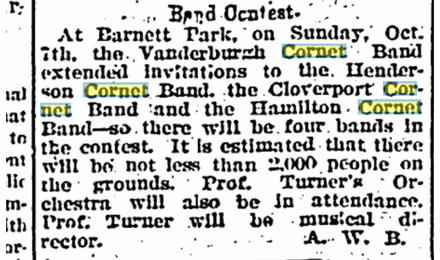
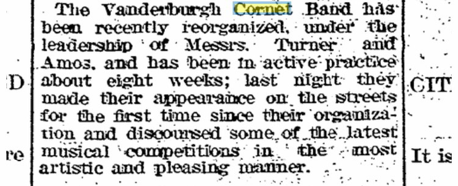
Another brass band of the time that stood out among those organizations listed in Elliot’s historical account was the Vanderburgh Cornet band—a traditionally black band. In my research, I was able to find a handful of articles on the group (to my pleasant surprise). It can be inferred the band competed in competitions, played at minstrel shows, and performed for social gatherings/parties. The group was held in a slightly higher regard than most black people then, and the public praised them for their musical abilities. However, the back handed compliment “They sound great… for a colored band” is consistently present in these newspaper articles. Still, the Vanderburgh Cornet band garnered attention and success despite the ubiquity of racism that endured. Below are the articles describing the brass band:
Liederkranz/Philharmonia German Singing Society
Recently, a group I was most drawn to in my research was the Philharmonia (originally the Liederkranz) German singing society. When they were formerly the Liederkranz, they held rehearsals at Turner Hall (owned by the family of the same name), however, the hall was destroyed in a fire later. In December 1880, Turner Hall was rented by the Liderkranz, and its name was changed to “Liederkranz Hall.” These are the directors in succession of one another as earlier as I could find:
- Professor Mathias
- Professor Wershinger (from New York)
- Professor Wolfsohn
- Professor Yunck
- Professor Lust
- Professor Schmidt
- Professor Walz (he took over because Prof. Schmidt died; he and the ensemble has creative differences so he was invited to leave before his year of directorship was up)
- Professor Cintura
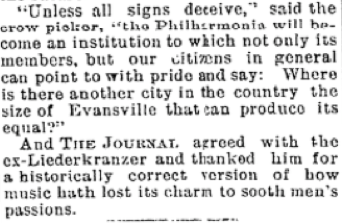
After Professor Cintura became the director of the Liederkranz, the German singing society and The Symphony Club (organization responsible for the director’s salary and concert expenses) went bankrupt. The groups made the decision to desert the Liederkranz and Symphony Club and create a new society called the Philharmonia. Only certain members of the old society were asked to join to make sure everyone was in agreement with the new group. The choice to initiate this new singing society was looked upon favorably by those inside and outside the group, and they had a starting number of sixty members. It’s interesting and also amusing to see the style of how things were reported on as this article excerpt shows; an ex-Liederkranz member gives their opinion on the future success of the Philharmonia:
Concordia Singing Society
Madeline Cox
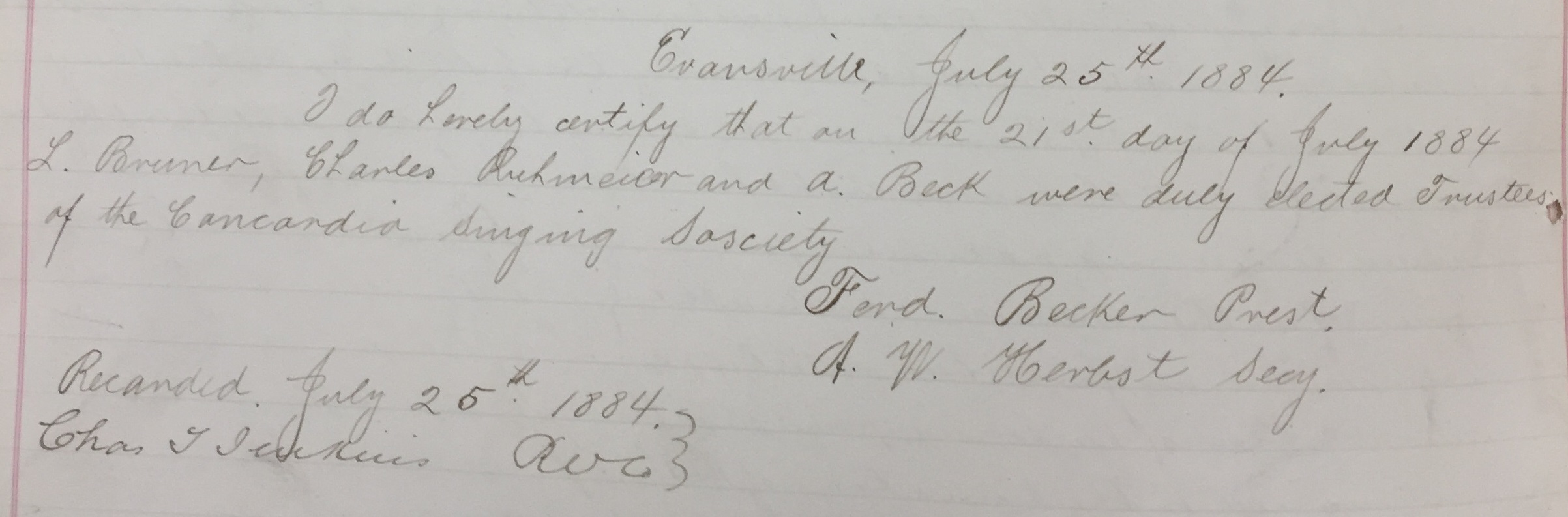
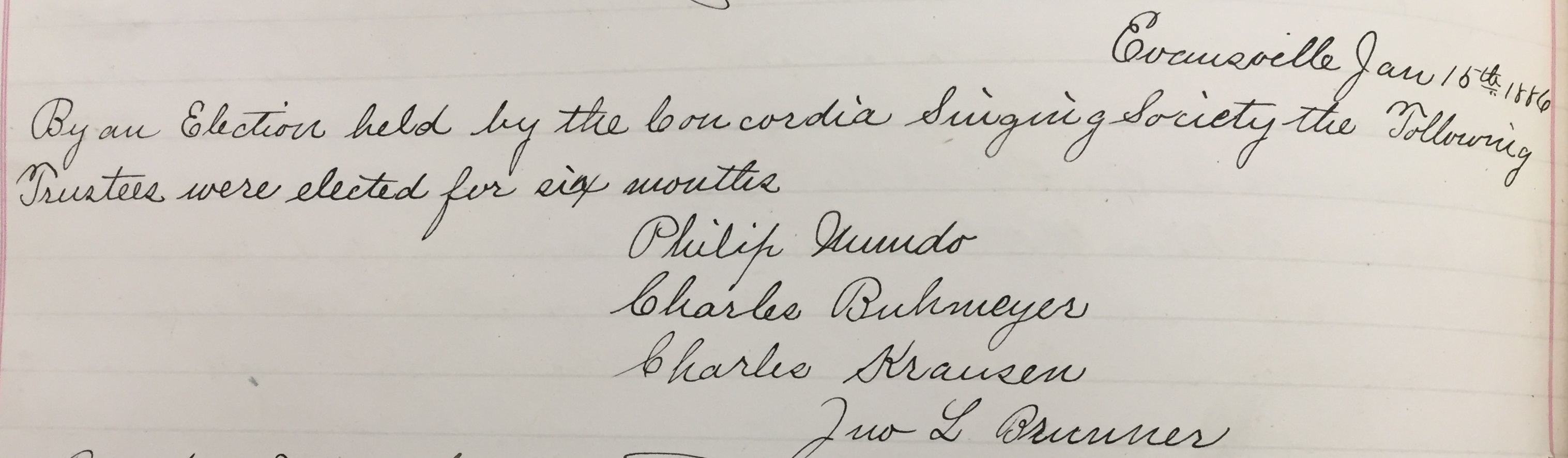
The Concordia Singing Society is one of the most interesting music societies in Evansville’s history. It was founded by Professor Cintura. This society has had a rich history of involvement. There have been a few different directors of the program in years past, including Professor August Schmidt of Baltimore in 1898.
Evansville natives were very interested in the concept of singing societies. At the turn of the century, there were fourteen music societies involved in the Evansville Musician’s Association, including the Concordia Singing Society. The Musician’s Association was an active part of the American Federation of Musicians. Thus, the Concordia Singing Society was part of a larger and prestigious group of musicians in the United States.
The singing society was well known in Evansville for the continuity of performances. They sang at many events, be it political, social, or entertainment. One of their most successful events was on April 11th, 1891 in Concordia Hall. This was a ball for wealthy locals, and had a significant turnout. The held performances in Webber Hall regularly and had many people come out to support them and enjoy their music.
The members of the Concordia Singing society were all very important to the structure of the group. Each one was held to a level of importance. Whenever a member of the society passes away, members old and new will join together to give a dedication service for the one who passed.
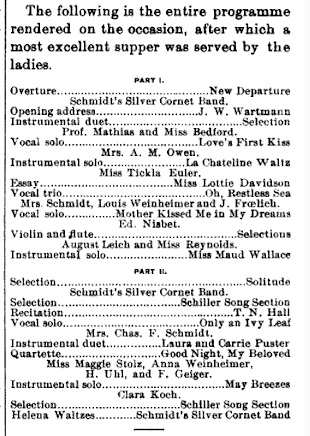
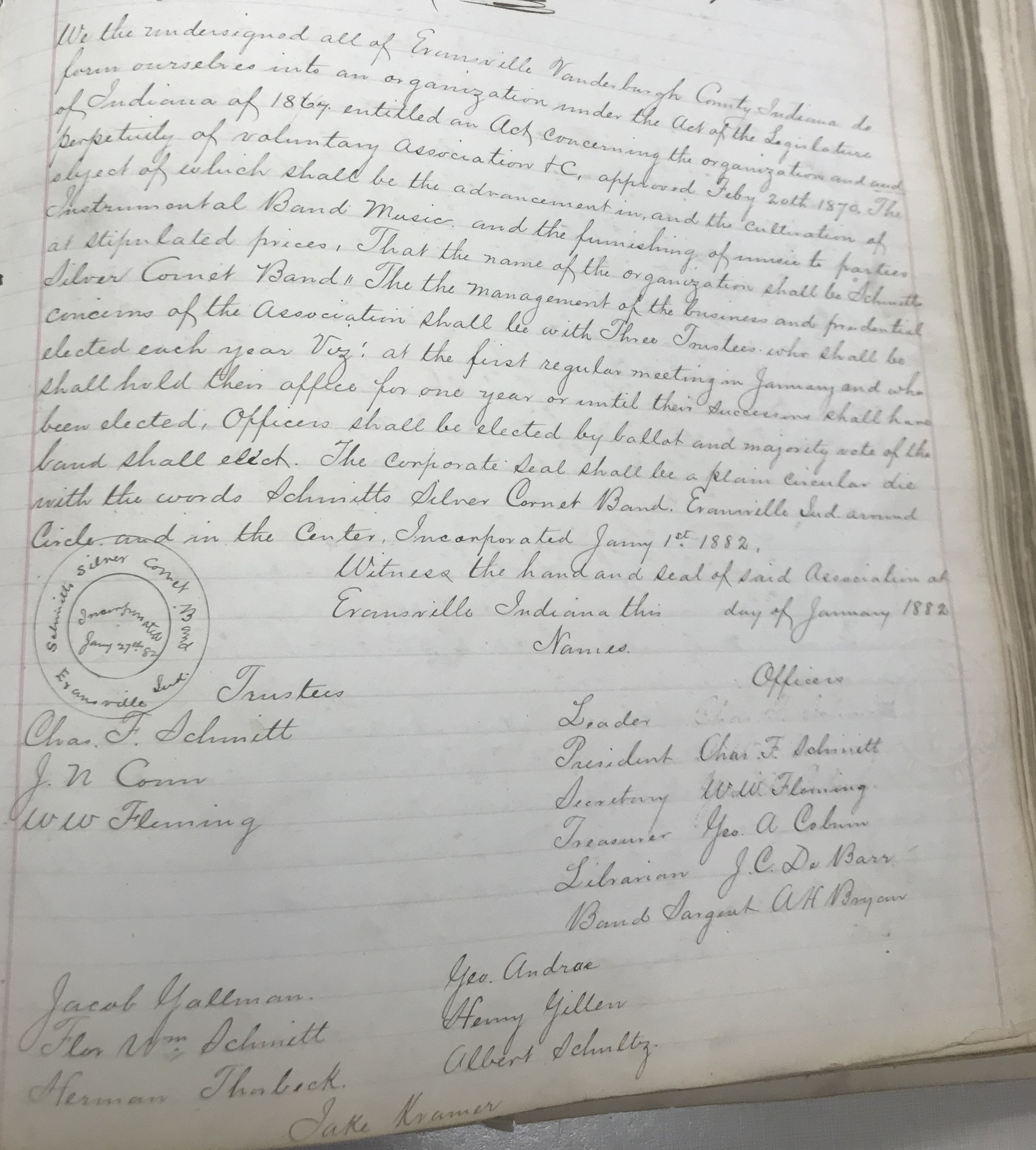
Schmidt’s Silver Cornet Band
Other local ensembles up to c.1900 include:
- Schiller Gesang Section Singing Society, 1857
- Maennerchor: 1872
- Schreiber’s orchestra, 1873
- Schmidt’s Orchestra, 1888
- Evansville Musical Association, 1891
- Arion Singing Society, successor of the Liederkranz, 1892
- Haynie’s Cornet Band, 1895
- F.W. Cook Military Band, 1896
- Strouse High Art Band, 1896
- Germania Maennerchor, 1900
- Forster’s orchestra
- Miller’s Orchestra
- Green’s orchestra
- Green’s Mandolin club
 Music in Evansville, Indiana: Civil War to WWII